
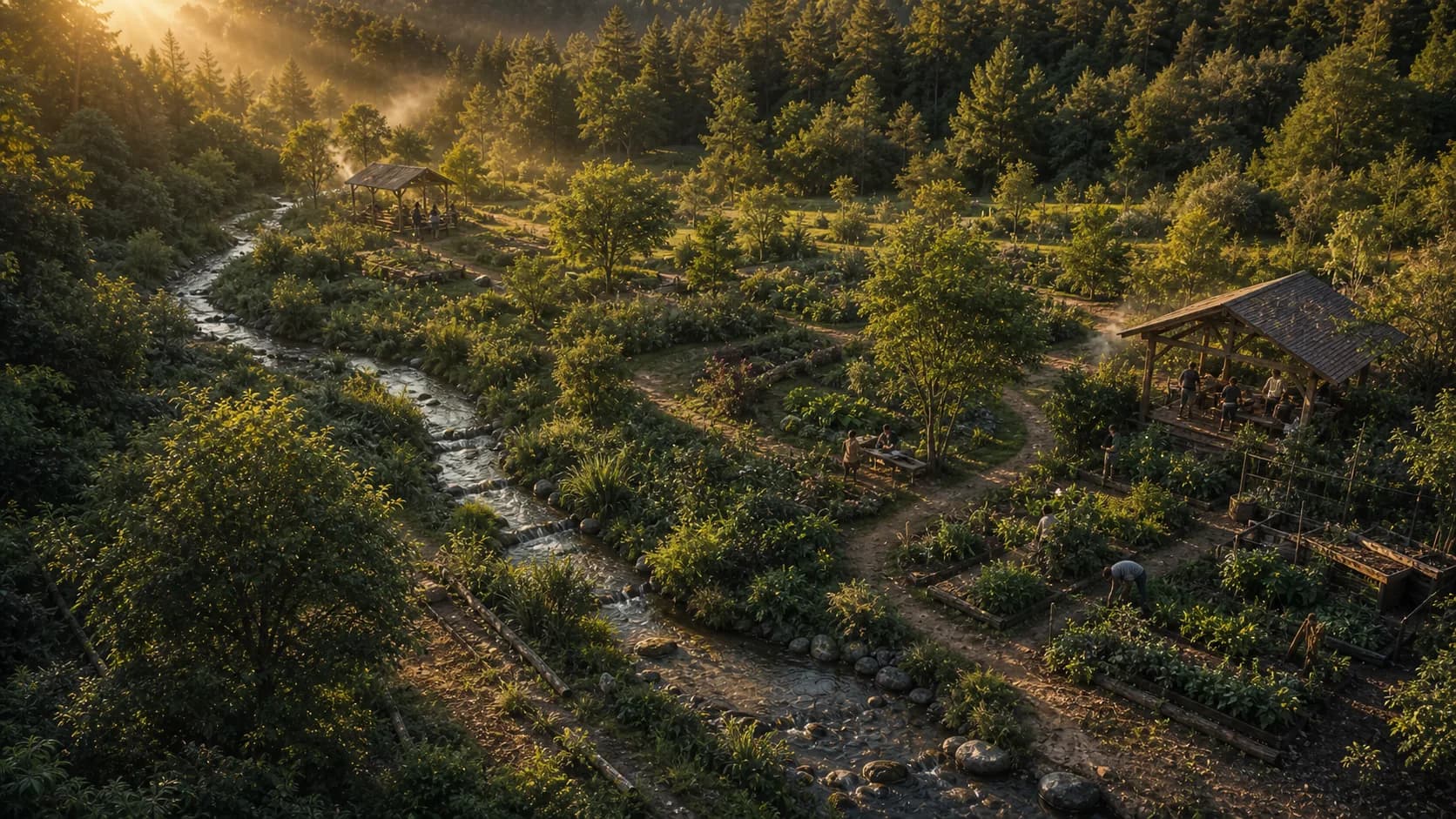
Food forest design for homes, farms, and schools
A food forest is a garden built like the edge of a woods, layered with things you can eat. We design them around your land, your harvest, and the time you actually have.
- Good for
- Homes, farms, schools, and community spaces that want to grow food for years, not just one season.
- What you get
- A layered planting plan built around what you want to harvest, the wildlife you want around, and how much care you can give it.
What a food forest is
A forest never replants itself in spring. It layers: tall trees, smaller trees, shrubs, herbs, ground covers, roots, and vines, each catching light the layer above it missed. A food forest keeps that shape and fills it with fruit, nuts, berries, herbs, and the plants that support them.
A guide written for the USDA National Agroforestry Center describes food forests as multiple vertical layers of woody and non-woody plants that mimic the layers of a forest. Most of the planting is perennial, so the work shifts over the years from replanting to tending and harvesting.
How we design one
Good food forests start with reading the land, not choosing plants. We look at where the sun falls through the seasons, how water moves after rain, what the soil is like, and how you'll walk in to pick. Then we design the layers around that.
- Read the site: sun, shade, slope, drainage, soil texture, and what's already growing.
- Plan for mature size: spacing each tree for its full-grown canopy, with extra room so the layers below still get light, as forest garden guidance from NCAT and the University of Missouri recommends.
- Choose plants that suit your climate and what you want to harvest, and avoid species that are invasive in your state.
- Phase the planting: what goes in first, what fills in later, and what gets thinned as the canopy grows.
- Leave you with a care plan sized to the time you can give it.
What to expect
Food forests reward patience. Iowa State University Extension puts the average wait for a first harvest at 4 to 5 years for apples and 3 to 5 years for tart cherries and plums; berries and perennial herbs fill the early years.
They are also mostly hand-tended. Research on food forests is young: a study of more than 200 food forests by Albrecht and Wiek found strong social and environmental benefits, with economic viability as the main weakness. We'll be straight with you about what your planting can and can't do.
Anywhere in the U.S., with honest limits
We offer consultation and design across the United States. Whether we can install depends on the site, the season, permits, the trades involved, and who's available locally. Our fieldwork is insured through Terramorph, and when a project requires state- or trade-specific credentials, we coordinate the right licensed professionals.
How we work, in five steps
- ListenEvery piece of land comes with people attached. We sit down with you and ask a lot of questions: what you want this place to do, what frustrates you about it now, and what you'd never change.
- ReadLand is never a blank page. We walk the site slowly and more than once: where water runs and pools after a storm, where shade falls in July, what the soil is like, what's already growing, and which animals use the place.
- DesignA good design is mostly decisions about relationships. We turn what we found into a plan: what goes where, what to plant, how water moves, where people walk, and how much upkeep you can honestly handle.
- BuildTiming is half of planting. We put it in the ground, sequencing jobs and materials around the weather and site conditions, and working around the plants and wildlife already living there.
- StewardA landscape is never finished, because it's alive. We come back to see what took off, what struggled, and what didn't make it, and we adjust.
Read before you call
Sources
- Urban Agroforestry Tipsheet: Food Forests and Beyond NCAT for the USDA National Agroforestry Center
- Introduction to Forest Garden Planning, Design, and Maintenance NCAT/ATTRA and the University of Missouri Center for Agroforestry
- How soon will a newly planted fruit tree begin to bear fruit? Iowa State University Extension
- Food forests: their services and sustainability (Albrecht & Wiek, 2021) Journal of Agriculture, Food Systems, and Community Development