
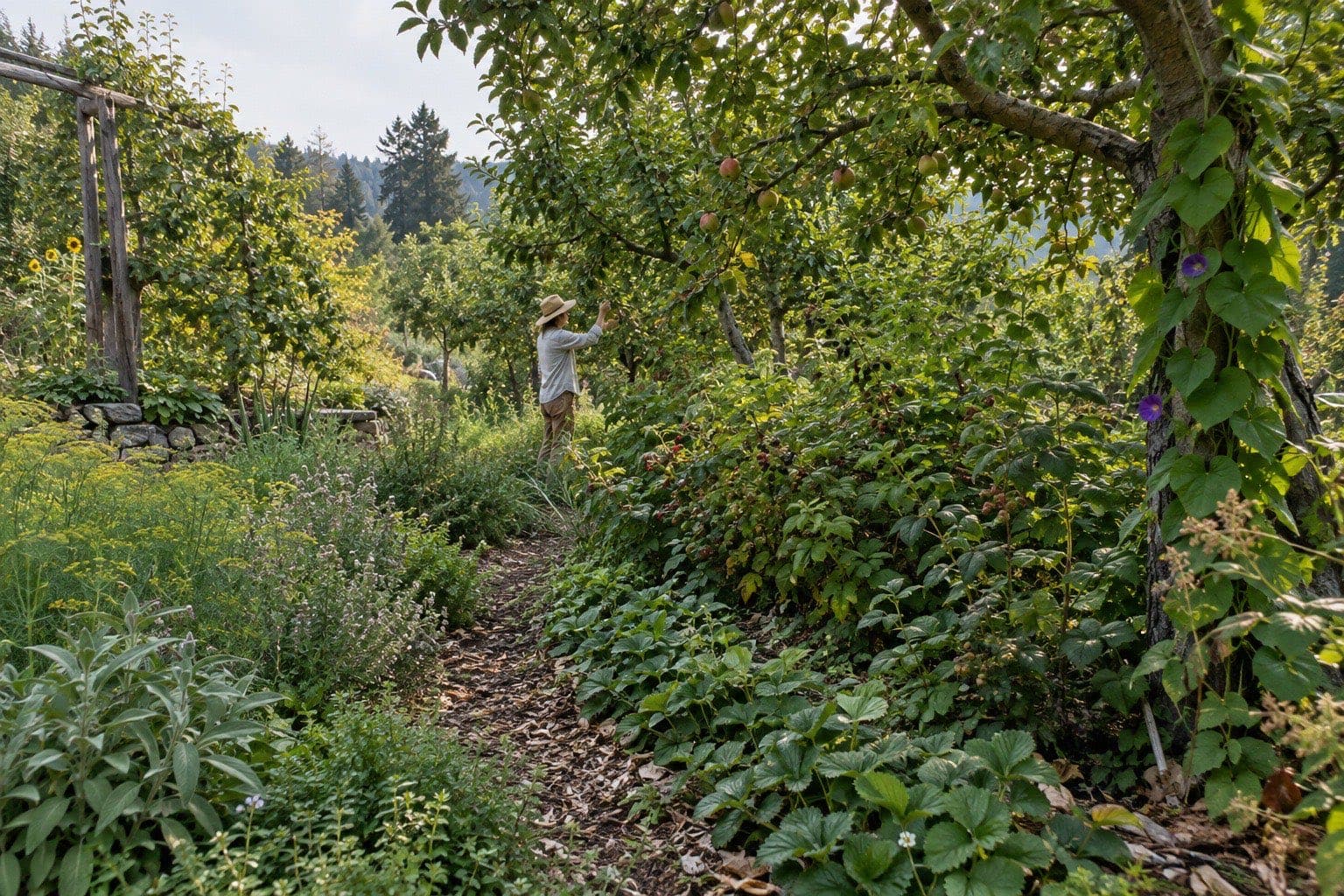
How to design a food forest in layers
A food forest borrows the shape of a woodland edge and fills it with food. Here is how the layers work, how to plan for the trees you'll have in twenty years, and what to honestly expect.
A forest that feeds you
A forest doesn't plant rows. It grows in layers, each one living off the light the layer above it let through. A food forest copies that shape and chooses plants you can eat, use, or that help the plants you eat.
A guide for the USDA National Agroforestry Center describes food forests, also called edible forest gardens, as multiple vertical layers of woody and non-woody plants that mimic the layers of a forest. That's different from what the USDA calls forest farming, which means growing specialty crops like ginseng or shiitake under an existing, thinned woodland. A food forest is usually planted from scratch.
The layers
The English gardener Robert Hart, who turned a small orchard in Shropshire into a forest garden, is widely credited with popularizing a seven-layer model. More recent guides add a fungi layer. A 2025 forest garden guide from NCAT/ATTRA and the University of Missouri Center for Agroforestry lists eight, and notes that the layers often overlap:
You don't need all of them. University of Minnesota Extension notes that food forests typically have three to seven layers. A small yard might have one tree, a few shrubs, and a living ground cover, and still work the same way.
- Canopy: tall trees, roughly 25 to 100 feet, such as chestnuts or walnuts.
- Understory trees: smaller trees, roughly 7 to 25 feet, such as apples, pears, or pawpaws.
- Shrubs: roughly 3 to 10 feet, such as currants, blueberries, or hazelnuts.
- Herbaceous plants: perennial herbs and vegetables.
- Ground cover: low plants that keep soil covered.
- Vines: climbers like grapes or hardy kiwi.
- Roots: root crops and tubers.
- Fungi: mushrooms grown on logs or in mulch.
Plan for the forest you'll have in twenty years
The most common mistake is planting for how small things are today. The NCAT guide recommends looking up each tree's spacing based on its mature canopy, then adding 30 to 50% more so the canopies don't close over the layers beneath them.
Light is the currency of a food forest. Lower layers will be shaded, so choose shade-tolerant plants for them, or space and prune the trees to let light through. In the Northern Hemisphere, putting the tallest plants on the north side keeps them from shading shorter ones, the same advice Virginia Cooperative Extension gives for vegetable gardens. Watch how shade moves across your site through the seasons before you plant anything permanent.
Think in decades. The NCAT guide suggests sketching the planting at 5, 10, 15, and 20 years, planting fast-growing nurse plants early, and expecting to cut back or remove some of them as the slower trees take over.
Nitrogen fixers, with care
Many food forest plans include plants that work with soil bacteria to fix nitrogen. Some of the most popular ones cause trouble. University of Connecticut Extension describes autumn olive as invasive from Maine to northern Florida and west to Nebraska: it fixes nitrogen and also crowds out native shrubs. Siberian peashrub is a restricted invasive species in Wisconsin. Goumi is on Tennessee's list of potential invasives.
Even a native can spread too well. The USDA Forest Service notes that black locust, native to the Appalachian region, often becomes invasive elsewhere through heavy seeding and root sprouts. Before planting any nitrogen fixer, check your state's invasive species list.
Be skeptical of "dynamic accumulators" too, plants like comfrey said to mine nutrients from deep soil. Cornell Small Farms found the evidence for that idea is almost entirely anecdotal.
Guilds: a useful idea, lightly tested
A guild is a group of plants placed together to reduce competition and increase the ways they help each other: a fruit tree with nitrogen-fixing shrubs, flowers for pollinators, and a ground cover that holds moisture. The NCAT guide uses the term that way, and it is a sensible way to think.
It is worth being honest about the evidence. A 2014 review of permaculture in Agronomy for Sustainable Development by Rafter Ferguson and Sarah Taylor Lovell found the movement relatively isolated from scientific research and weakened by oversimplified claims. We couldn't find controlled trials of specific guild combinations. Treat guild charts as practitioners' experience, then watch what actually works on your land.
When you'll actually harvest
Fruit and nut trees take time. Iowa State University Extension gives average years to first fruit of 4 to 5 for apples, 4 to 6 for pears, and 3 to 5 for tart cherries and plums, with dwarfing rootstocks bearing sooner. Chinese chestnut produces its first nuts in about 3 to 4 years, grows 40 to 60 feet tall, and needs two trees to pollinate.
Pawpaw, a native fruit tree that does well in light shade when young, can flower 2 to 3 years after planting if grafted, and needs two different varieties to set fruit, according to Kentucky State University's pawpaw program. Berries and perennial herbs fill the gap in the early years.
What the research says about food forests
The research is young. A 2026 scoping review of temperate food forest research found it fragmented and named food production as a key gap. Researchers Sarah Albrecht and Arnim Wiek, studying more than 200 food forests, found they scored well on social and environmental measures, with economic viability as their main weakness. In Belgium, the research institute ILVO modeled 21 Flemish food forests and found only 2 produced a full income.
That doesn't make food forests a poor idea. It means they are a long-term, mostly hand-tended way to grow food, shade, and habitat, not a quick business plan. Seattle's Beacon Food Forest, a 7-acre public site designed in 2009 and first planted in 2012, is run largely by volunteers.
Common mistakes to avoid
Most problems are predictable. The NCAT guides point to the same handful again and again.
- Planting too densely, without planning for mature size.
- Choosing species that are invasive in your state.
- Skipping a soil test on urban lots, where heavy metals can be a concern.
- Watering overhead in dense plantings, which encourages mildew.
- Leaving long-term care unclear: who prunes, who harvests, and when.
Sources
- Urban Agroforestry Tipsheet: Food Forests and Beyond NCAT for the USDA National Agroforestry Center
- What is forest farming? USDA National Agroforestry Center
- Introduction to Forest Garden Planning, Design, and Maintenance NCAT/ATTRA and the University of Missouri Center for Agroforestry
- Robert Hart (horticulturist) Wikipedia
- Planting a community food forest University of Minnesota Extension
- Edible Landscaping & Food Forests (MC-04302) South Dakota State University Extension
- Planning the Vegetable Garden (426-312) Virginia Cooperative Extension
- Autumn Olive (EXT072) UConn Extension
- Siberian peashrub Wisconsin Department of Natural Resources
- Invasive Plant List Tennessee Invasive Plant Council
- Plant of the Week: Black Locust USDA Forest Service
- Breaking ground with dynamic accumulators Cornell Small Farms Program
- Permaculture for agroecology (Ferguson & Lovell, 2014) Agronomy for Sustainable Development
- How soon will a newly planted fruit tree begin to bear fruit? Iowa State University Extension
- What is a Chinese chestnut? Iowa State University Extension
- Pawpaw FAQ Kentucky State University
- Food forests: their services and sustainability (Albrecht & Wiek, 2021) Journal of Agriculture, Food Systems, and Community Development
- A scoping review of temperate food forestry research (Roodhof et al.) European Commission Knowledge for Policy
- Food forest as a revenue model reviewed for the first time ILVO (Flanders Research Institute for Agriculture)
- About Beacon Food Forest Beacon Food Forest
General guidance, not advice for a specific site. Local conditions, rules, and your county extension office come first.