How to read your soil and water before you plant
Your land has already written down most of what you need to know. These are the simple tests that let you read it: with your hands, a jar, a shovel, and one good rainstorm.
Look before you plant
Every plan starts with a question the land has usually already answered: where does the water go, and what is the ground made of? Get those wrong and even the right plants struggle. Get them right and a lot of other decisions make themselves.
None of what follows needs special equipment. A glass jar, a shovel, a ruler, and some patience will tell you more about your site than most catalogs will. Do the tests in a few different spots, because a single yard can hold several kinds of ground.
Feel your soil: the ribbon test
Soil is a mix of three particle sizes. Sand feels gritty, silt feels smooth like flour, and clay feels sticky. The mix, called texture, decides how fast water drains and how much the soil holds.
Clay has an outsized effect. Colorado State University Extension notes that a soil with as little as 20% clay already behaves like a clay soil, so a little goes a long way.
Measure it: the jar test
For a closer read, let gravity sort the particles for you. Sand settles in about a minute, silt over a couple of hours, and fine clay can take a day or two to settle out of cloudy water. Clemson Cooperative Extension measures clay at 48 hours; other extension services use slightly different timings, so treat the result as a good estimate rather than a lab number.
How fast does water soak in?
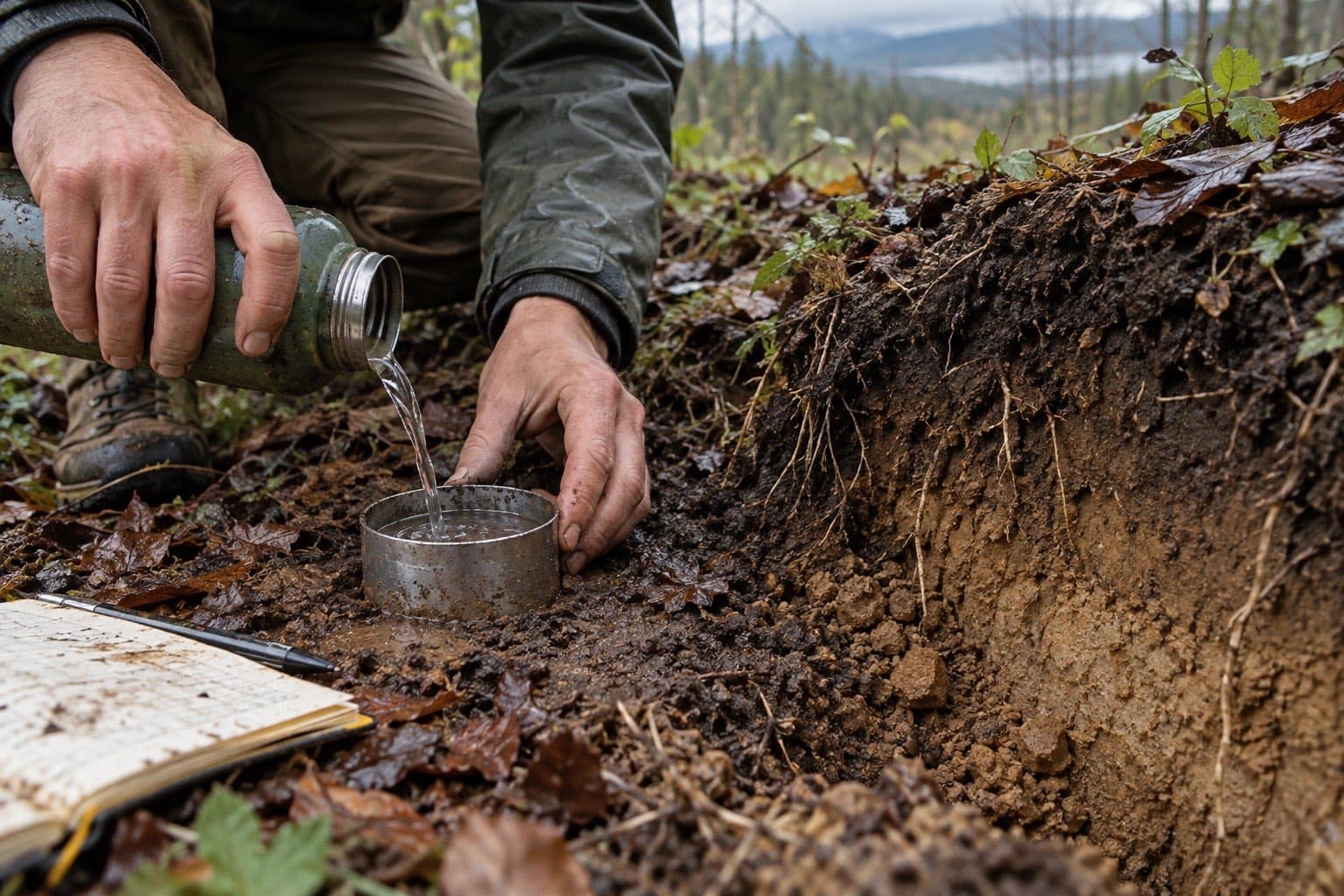
Texture tells you what the soil is. A drainage test tells you how it behaves. Iowa State University Extension describes a simple version anyone can do, and gives a useful range: about 1 to 3 inches of drainage an hour suits most plants, under 1 inch is poor, and over 4 is very fast.
One caution from the same guide: don't dig when the soil is very wet. The shovel smears the sides of the hole and seals them, which makes the drainage look worse than it is.
If you want something more precise, the USDA Natural Resources Conservation Service publishes a soil health infiltration test that times one inch of water soaking into a small metal ring.
Is it compacted?
Compacted ground acts like a lid. Water runs across it instead of into it, and roots can't push through. Compaction usually comes from traffic: vehicles, livestock, construction, or years of the same footpath.
The field guide Building Soils for Better Crops, published by SARE, suggests pushing a wire flag into moist soil in ten or more places. In healthy soil it slides in with little or no resistance. If a spade suddenly gets harder to push about 6 to 8 inches down, you may have a compacted layer. Roots tell the same story: short, stubby roots that turn sharply at a hard layer are a warning sign. Healthy roots branch freely.
Watch it rain
The single best soil test is a storm. Penn State Extension recommends walking your property while it rains to see where water flows and where it collects. Go back out afterward: small rills and gullies mean water is moving fast enough to carry soil away.
Then wait a day. A USDA site assessment guide for rain gardens treats standing water that is gone within 24 hours of a heavy rain as a good sign, and water still standing after two days as a problem. Water that sits for more than 72 hours can also breed mosquitoes.
- Note where downspouts empty and where that water ends up.
- Mark low spots that stay wet and high spots that dry out first.
- Look for bare patches, crusted surfaces, and fans of washed-out soil downhill.
Why covered ground holds water better
Bare soil takes a beating. NRCS soil health guidance describes how a cover of plants or mulch absorbs the force of falling rain, slows evaporation, evens out soil temperature, and protects against wind and water erosion. Rain falling on bare ground is one of the things that compacts it.
You'll often hear that every 1% of organic matter lets an acre hold tens of thousands of extra gallons. The research is more modest. A review of about 60 studies by Minasny and McBratney found the extra water storage from more organic carbon is real but small. As the University of Nebraska–Lincoln puts it, organic matter's bigger gift is helping water soak in. Keeping the ground covered is how you get both.
When to call in a lab
Home tests read the soil's structure. A lab test reads its chemistry: pH, organic matter, nutrients, and sometimes salts or lead. Most land-grant universities run soil labs through their extension services, usually for a modest fee.
Colorado State University Extension points out what a lab test won't tell you: drainage, compaction, insects, or disease. That's what the tests above are for.
Look twice a year, and skip the sand
Soil changes with the seasons, and so do its problems. The SARE guide notes that many problems are easiest to see during wet or dry spells, so look at your land at both extremes before you commit. Washington State University also suggests starting with the free USDA Web Soil Survey to see what's mapped under your property.
One myth worth retiring: mixing sand into clay to loosen it. Iowa State University Extension recommends organic matter instead. The University of Saskatchewan explains why: it takes roughly half the soil's volume in sand to change a clay's texture, and the real trouble with clay is poor structure, which sand doesn't fix. Compost on top and a layer of mulch do far more.
Sources
- Estimating Soil Texture: Sandy, Loamy, or Clayey (GardenNotes #214) Colorado State University Extension
- Soil Texture Analysis: The Jar Test Clemson Cooperative Extension
- Testing and Improving Soil Drainage Iowa State University Extension
- Soil Health – Infiltration USDA Natural Resources Conservation Service
- Building Soils for Better Crops, 4th ed., Field Indicators Magdoff & van Es, SARE
- How to Make a Rain Garden Penn State Extension
- Rain Garden Site & Soil Assessment Card USDA Natural Resources Conservation Service
- Soil Health Principles USDA Natural Resources Conservation Service
- Limited effect of organic matter on soil available water capacity (Minasny & McBratney, 2018) European Journal of Soil Science
- The connection between soil organic matter and soil water University of Nebraska–Lincoln Water
- Soil Sampling Depth and Collection Techniques (G9070) University of Missouri Extension
- Soil Tests (GardenNotes #221) Colorado State University Extension
- Soils, Drainage, Subsurface Water Washington State University Extension
- Adding sand to clay soils is not recommended University of Saskatchewan
General guidance, not advice for a specific site. Local conditions, rules, and your county extension office come first.