Regenerative agriculture planning for farms and homesteads
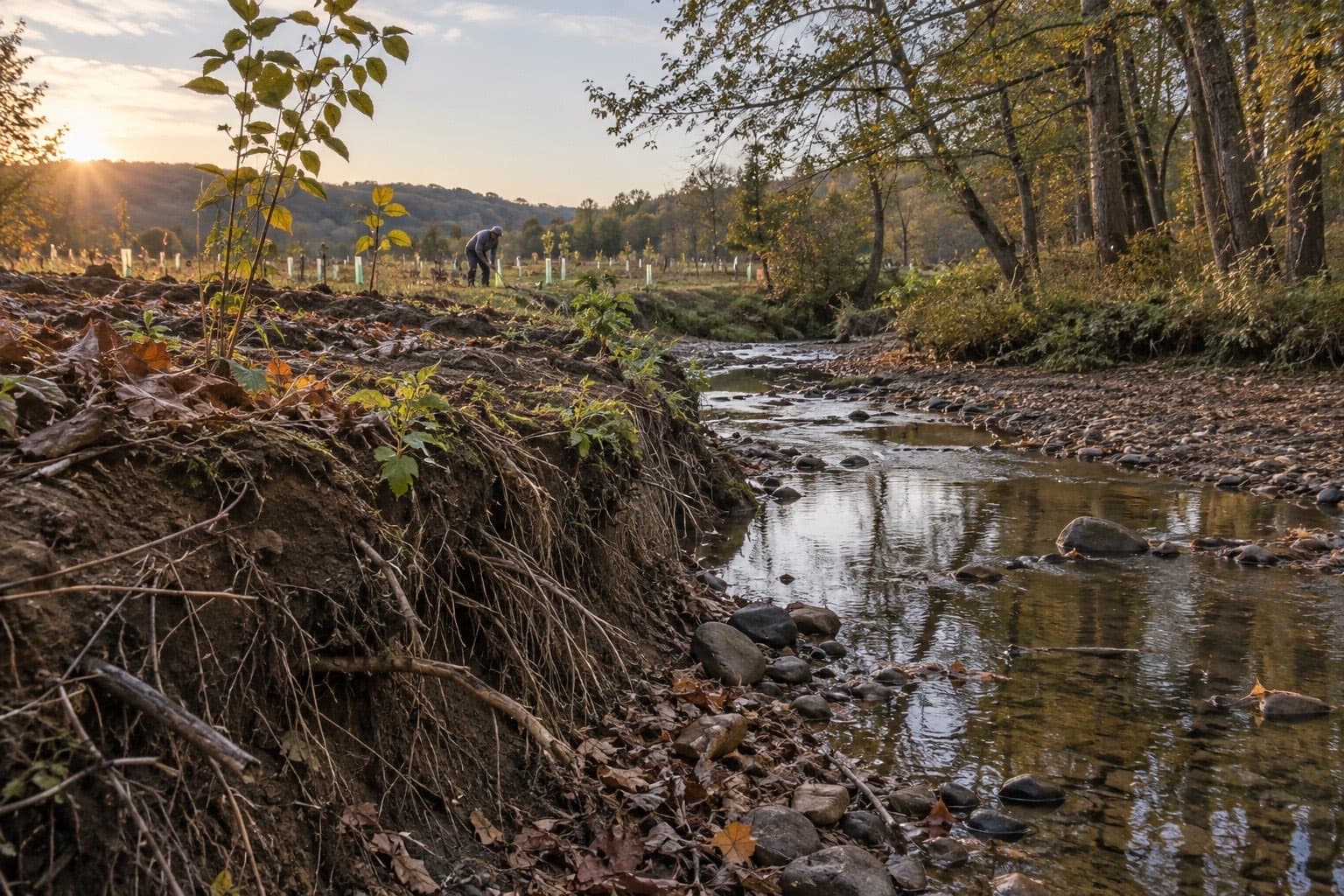
Soil is slow to make and quick to lose. We help farms and homesteads build it back: keeping the ground covered, slowing water, mixing plants, and making room for wildlife.
- Good for
- Farms, homesteads, and acreage where the owners want healthier soil and a better way of working the land.
- What you get
- A plan for your land: where water goes, what to plant, how you'll get around, and what to tackle in what order.
Soil is the long game
The UN Food and Agriculture Organization notes that it can take up to a thousand years to form a few centimeters of soil. Every hard rain on bare ground spends some of that savings.
Regenerative agriculture has no single legal definition. A 2020 review by Newton and colleagues found it defined by practices, like cover crops and reduced tillage, by outcomes, like soil health, or by both. We use it to mean farming that leaves the soil, water, and wildlife on your land in better shape over time.
What we look at
We start with how your land behaves: slope, compaction, drainage, what's growing now, how you get around, and how much time you have. Then we help you decide where to start.
- Where water runs off, pools, or carries soil away after storms.
- Compaction and crusting, using simple field checks like a wire flag and a spade.
- Ground cover through the year, because covered soil resists erosion and keeps moisture.
- Where strips of perennial plants, hedgerows, or trees could slow water and shelter wildlife.
Small changes, big effects
Some of the most effective moves take little land. Iowa State University's STRIPS research reports that converting 10% of a crop field to strips of native prairie cut sediment loss by 95%. Results vary by field, but the principle holds: put living roots where the water moves.
What you get
A plan for your land: where water goes, what to plant, how you'll get around, and what to tackle in what order, sized to the time and money you actually have.
Anywhere in the U.S., with honest limits
We offer consultation and design across the United States. Whether we can install depends on the site, the season, permits, the trades involved, and who's available locally. Our fieldwork is insured through Terramorph, and when a project requires state- or trade-specific credentials, we coordinate the right licensed professionals.
How we work, in five steps
- ListenEvery piece of land comes with people attached. We sit down with you and ask a lot of questions: what you want this place to do, what frustrates you about it now, and what you'd never change.
- ReadLand is never a blank page. We walk the site slowly and more than once: where water runs and pools after a storm, where shade falls in July, what the soil is like, what's already growing, and which animals use the place.
- DesignA good design is mostly decisions about relationships. We turn what we found into a plan: what goes where, what to plant, how water moves, where people walk, and how much upkeep you can honestly handle.
- BuildTiming is half of planting. We put it in the ground, sequencing jobs and materials around the weather and site conditions, and working around the plants and wildlife already living there.
- StewardA landscape is never finished, because it's alive. We come back to see what took off, what struggled, and what didn't make it, and we adjust.
Read before you call
Sources
- Global Symposium on Soil Erosion: Key messages Food and Agriculture Organization of the United Nations
- What is regenerative agriculture? (Newton et al., 2020) Frontiers in Sustainable Food Systems
- Building Soils for Better Crops, 4th ed., Field Indicators Magdoff & van Es, SARE
- Soil Health Principles USDA Natural Resources Conservation Service
- STRIPS: Prairie strips Iowa State University