
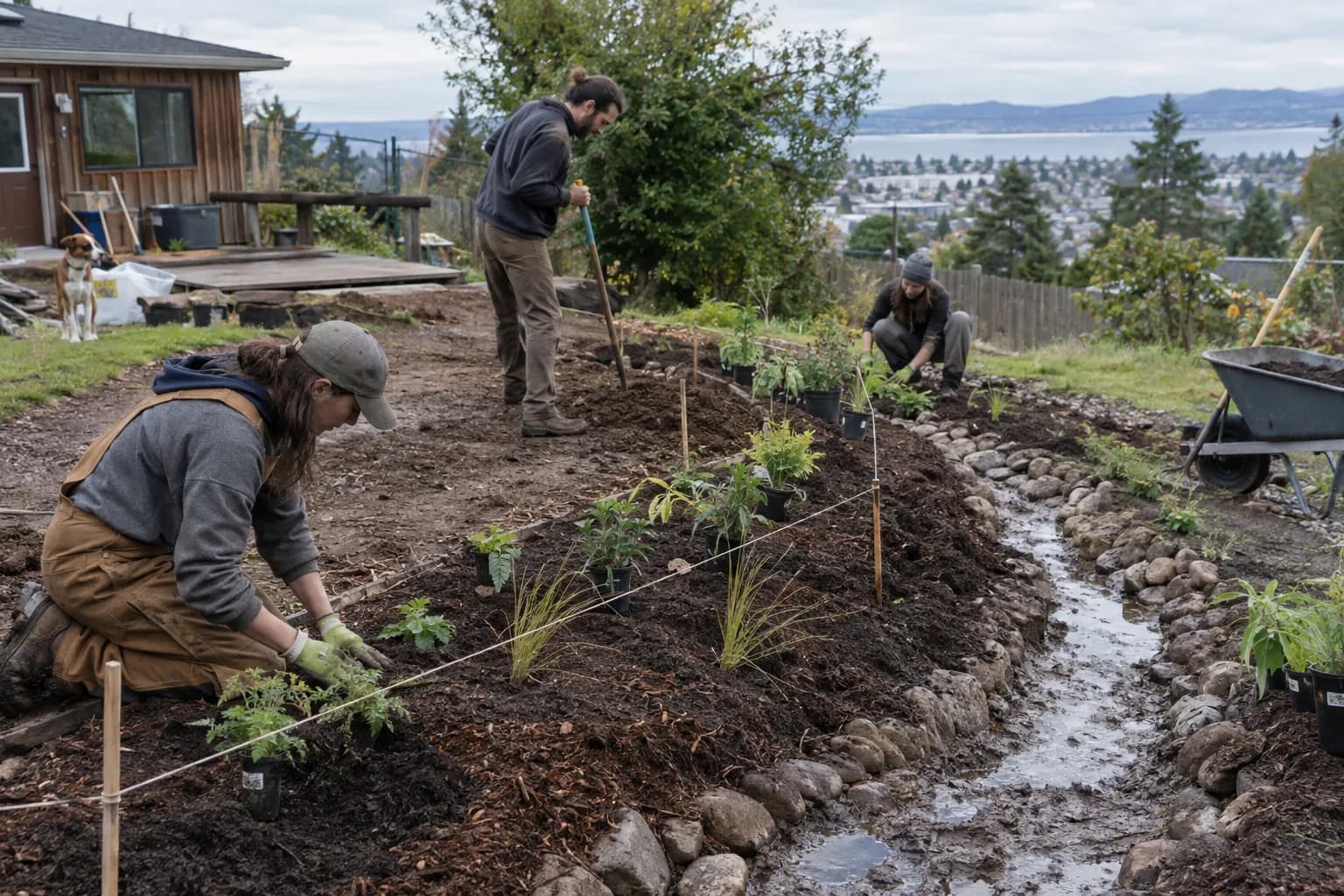
Slow it, spread it, sink it: rain gardens, swales, and rainwater at home
Every roof and driveway turns rain into runoff. With a few simple shapes in the ground, you can turn it back into water your land can use.
Why rain becomes a problem
Rain is a gift until it lands on something it can't soak into. Roofs, driveways, and streets are impervious: water runs straight off them. The U.S. Geological Survey explains that the more ground we cover, the less water can soak in, and the more often and more severely streams flood.
That runoff doesn't arrive clean. The EPA describes how it carries fertilizer, pesticides, oil, sediment, and bacteria into lakes, rivers, and groundwater, and notes that states identify this kind of pollution as the leading remaining cause of water quality problems.
The answer on a home or farm scale is simple to say: slow the water down, spread it out, and let it sink in.
Start with your soil, and call 811
Before you dig anything, find out how fast water soaks in where you want to build. Extension guides describe a simple test, with slightly different details. The University of Wisconsin rain garden manual suggests a hole 6 to 12 inches deep: fill it, let it soak for an hour, refill it, and measure the drop over the next hour. More than half an inch suggests the site will work. Penn State Extension advises looking elsewhere if a test hole takes more than 24 hours to drain.
Then make a free call. 811 is the national call-before-you-dig service, run by the Common Ground Alliance, and it asks for a call or click a few business days before every dig, so buried lines can be marked.
Rain gardens: a shallow bowl that drinks
The EPA describes a rain garden as a depressed area in the landscape that collects rainwater, planted with grasses and flowering perennials. It catches water from a downspout or driveway and lets it soak in over a day or so instead of running into the street.
It does real work. The University of Wisconsin manual estimates that a rain garden below a downspout on a typical quarter-acre lot reduces that lot's yearly runoff by about 25%.
- Depth: typically 4 to 8 inches, according to the Wisconsin manual. Deeper than that can hold water too long.
- Distance from the house: at least 10 feet, per the Wisconsin manual and Penn State. A USDA site guide rates more than 20 feet as favorable, to keep water away from basements.
- Drainage: Penn State says it should ideally drain within 12 to 24 hours and not hold water more than 48 hours. The Wisconsin manual notes mosquitoes need 7 to 12 days of standing water to breed.
- Plants: native plants that tolerate both wet spells and dry ones, with the thirstiest species in the lowest spots, as Penn State recommends.
How big should it be?
Size depends on how much roof or pavement drains to it and on your soil. Penn State Extension's how-to guide suggests a rain garden about 10 to 20% the size of the hard surface draining into it; its own example sizes a garden for a 625-square-foot roof at about 104 square feet with 6 inches of ponding.
The Wisconsin manual uses a size factor based on soil and depth. For a garden 6 to 7 inches deep near the downspout, for example, it multiplies the drainage area by 0.15 for sandy soil, 0.25 for silty soil, and 0.32 for clay. Clay drains slowly, so it needs a bigger garden. If the result is much more than 300 square feet, the manual suggests splitting it into several smaller gardens.
Swales on contour
On a slope, a swale is a shallow ditch dug along the contour, level across the hill, with the dug soil piled on the downhill side as a low berm. University of California Agriculture and Natural Resources describes how water collects in it and soaks in, and overflow can spill into another swale below. University of Arizona Extension adds that small crescent-shaped berms on the downhill side of individual plants can slow water the same way.
Swales aren't right everywhere. We couldn't find an official standard written for permaculture-style swales, but Oregon State University's guidance on infiltration swales is a sensible guide: avoid them within 10 feet of buildings or 5 feet of underground utilities, where bedrock or seasonal groundwater sits close to the surface, on slopes steeper than 10%, or anywhere landslides are a risk without an engineer's sign-off. Water held in the wrong place can do real damage.
Rain barrels and cisterns
The math is satisfying. Texas A&M AgriLife notes that one inch of rain on one square foot of roof yields about 0.62 gallons, so a 1,000-square-foot roof sheds roughly 620 gallons in a one-inch storm. A single barrel fills fast.
Treat it as garden water. Texas A&M advises screening every opening, which also keeps mosquitoes out, and giving the barrel an overflow, and says water from simple systems isn't suitable for drinking. University of Arizona Extension adds: secure tanks from children, label them as unfit for drinking, and set them a few feet from the foundation in case of leaks. The EPA notes that roof water can carry bacteria from birds and animals and chemicals from roofing, worth considering before using it on food plants.
- Send the overflow somewhere useful, like a rain garden or swale, and away from the foundation.
- Keep lids tight and screens intact.
- Use the water outdoors, on the soil rather than on the leaves of food crops.
Is it legal where you live?
Usually, but check. The National Conference of State Legislatures reports that most states leave rainwater collection largely up to residents, while 18 states have set limits of some kind. Colorado is the best-known example: under its 2016 law, Colorado State University explains, a household may use up to two barrels holding no more than 110 gallons total, filled from rooftop downspouts and used outdoors on the same property.
Rain gardens and swales are generally treated differently from storage, but local rules on grading, drainage, and setbacks still apply. Your state's water agency or county extension office can tell you what holds where you live.
Common mistakes
Most rain garden failures come from where they're built, not how. The Wisconsin manual, Penn State, and a USDA site assessment guide point to the same list.
- Building over a septic system, drain field, or sewer line. The USDA guide suggests staying more than 10 feet from a septic drain field.
- Choosing a spot where water already pools. Those wet spots are wet because water soaks in slowly there.
- Digging under a large tree, where you'll cut roots and fight them for space.
- Building too close to the house.
- Skipping the call to 811.
Sources
- Impervious Surfaces and Flooding U.S. Geological Survey
- Basic Information about Nonpoint Source Pollution U.S. Environmental Protection Agency
- Rain Gardens: A How-To Manual for Homeowners University of Wisconsin Extension and Wisconsin DNR
- How to Make a Rain Garden Penn State Extension
- What is a Rain Garden? Penn State Extension
- Soak Up the Rain: Rain Gardens U.S. Environmental Protection Agency
- Rain Garden Site & Soil Assessment Card USDA Natural Resources Conservation Service
- 811: Call before you dig Common Ground Alliance
- Harvesting Rainwater in Your Garden University of California Agriculture and Natural Resources
- Harvesting Rainwater for Landscape Use (AZ1344) University of Arizona Cooperative Extension
- Water Quality Swales: Low Impact Development Fact Sheet (EM 9209) Oregon State University Extension
- Beginner rainwater harvesting system tips Texas A&M AgriLife Today
- Soak Up the Rain: Rain Barrels U.S. Environmental Protection Agency
- Is Catching Rainwater Legal in Your State? National Conference of State Legislatures
- Extension offers fact sheet on how to harvest rainwater under new Colorado rules Colorado State University
General guidance, not advice for a specific site. Local conditions, rules, and your county extension office come first.