
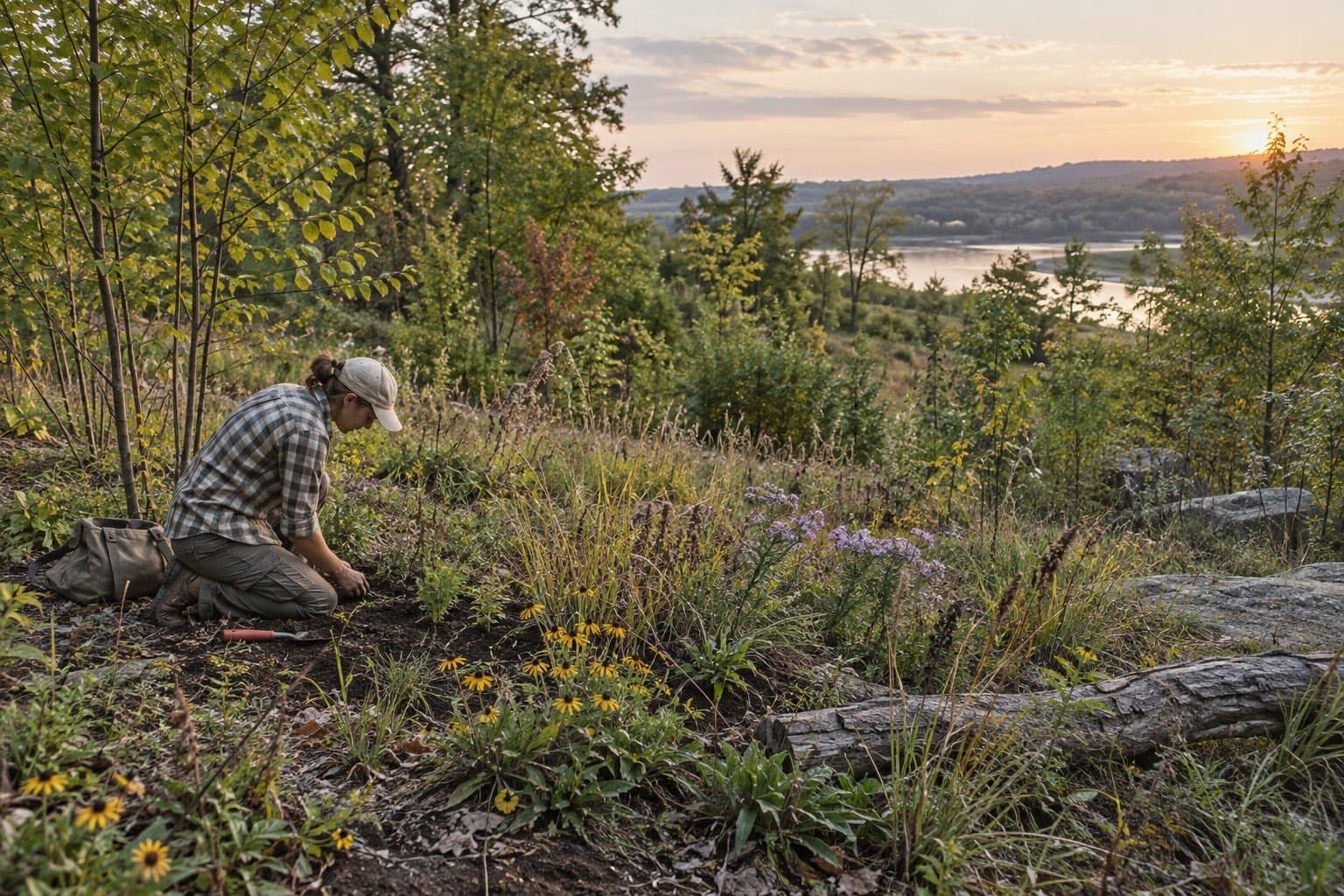
Native landscaping and habitat restoration
The right native plants feed the insects that feed the birds. We design plantings that fit your ecoregion, your soil, and your space, and that put that food web back together.
- Good for
- Homes, farms, schools, and shared land that want more native plants and more wildlife.
- What you get
- A list of what to restore first and a native planting plan that fits your site.
Why native plants
Belonging takes thousands of years to earn. Research led by Matthew Forister found that most plant-eating insects feed on plants from a single plant family, and most songbirds raise their young on those insects. Native plants restock the bottom of that food web.
A few plants do most of the work. A 2020 study by Narango, Tallamy, and Shropshire found that on average 14% of local plant genera supported more than 90% of butterfly and moth species, with oaks, willows, cherries, pines, and poplars leading the woody plants.
How we design a native planting
We start with what's already there: the plants, the soil, where water sits in spring, and what has been disturbed. Then we plan the repair, whether it's one garden bed or a few acres.
- Match plants to your ecoregion, the areas the EPA maps by shared geology, soils, climate, and plants, not just your state.
- Put each plant in the right spot for its light, moisture, and room to grow.
- Build around keystone plants that support the most wildlife where you live.
- Plan for pollinators, including bare ground for the many native bees that nest in soil.
- Source from local native nurseries where it matters most.
Removing what doesn't belong
Where invasive plants have taken hold, pulling them out is only half the job. University of Maryland Extension advises replanting with natives as soon as possible, because cleared ground is easily taken over again. We plan removal and replanting together.
What to expect
Native gardens are low-maintenance, not no-maintenance, as Purdue University's Landscape Report puts it. The familiar pattern is sleep, creep, leap: mostly roots in year one, more growth in year two, and a planting that fills in by year three. We'll leave you a care plan for those first seasons.
Anywhere in the U.S., with honest limits
We offer consultation and design across the United States. Whether we can install depends on the site, the season, permits, the trades involved, and who's available locally. Our fieldwork is insured through Terramorph, and when a project requires state- or trade-specific credentials, we coordinate the right licensed professionals.
How we work, in five steps
- ListenEvery piece of land comes with people attached. We sit down with you and ask a lot of questions: what you want this place to do, what frustrates you about it now, and what you'd never change.
- ReadLand is never a blank page. We walk the site slowly and more than once: where water runs and pools after a storm, where shade falls in July, what the soil is like, what's already growing, and which animals use the place.
- DesignA good design is mostly decisions about relationships. We turn what we found into a plan: what goes where, what to plant, how water moves, where people walk, and how much upkeep you can honestly handle.
- BuildTiming is half of planting. We put it in the ground, sequencing jobs and materials around the weather and site conditions, and working around the plants and wildlife already living there.
- StewardA landscape is never finished, because it's alive. We come back to see what took off, what struggled, and what didn't make it, and we adjust.
Read before you call
Sources
- The global distribution of diet breadth in insect herbivores (Forister et al., 2015) PNAS
- Native cultivars and insect feeding (Baisden et al., 2018) HortTechnology
- Few keystone plant genera support the majority of Lepidoptera species (Narango, Tallamy & Shropshire, 2020) Nature Communications
- Ecoregions U.S. Environmental Protection Agency
- Wild bees Xerces Society
- Removing Invasive Plants and Planting Natives University of Maryland Extension
- Establishing a native perennial garden: sleep, creep, leap Purdue Landscape Report