
Hugelkultur: what the evidence actually says
Hugelkultur, burying wood under mounds of soil, is one of permaculture's most popular ideas. It's also one of the least studied. Here's an honest look.
What it is
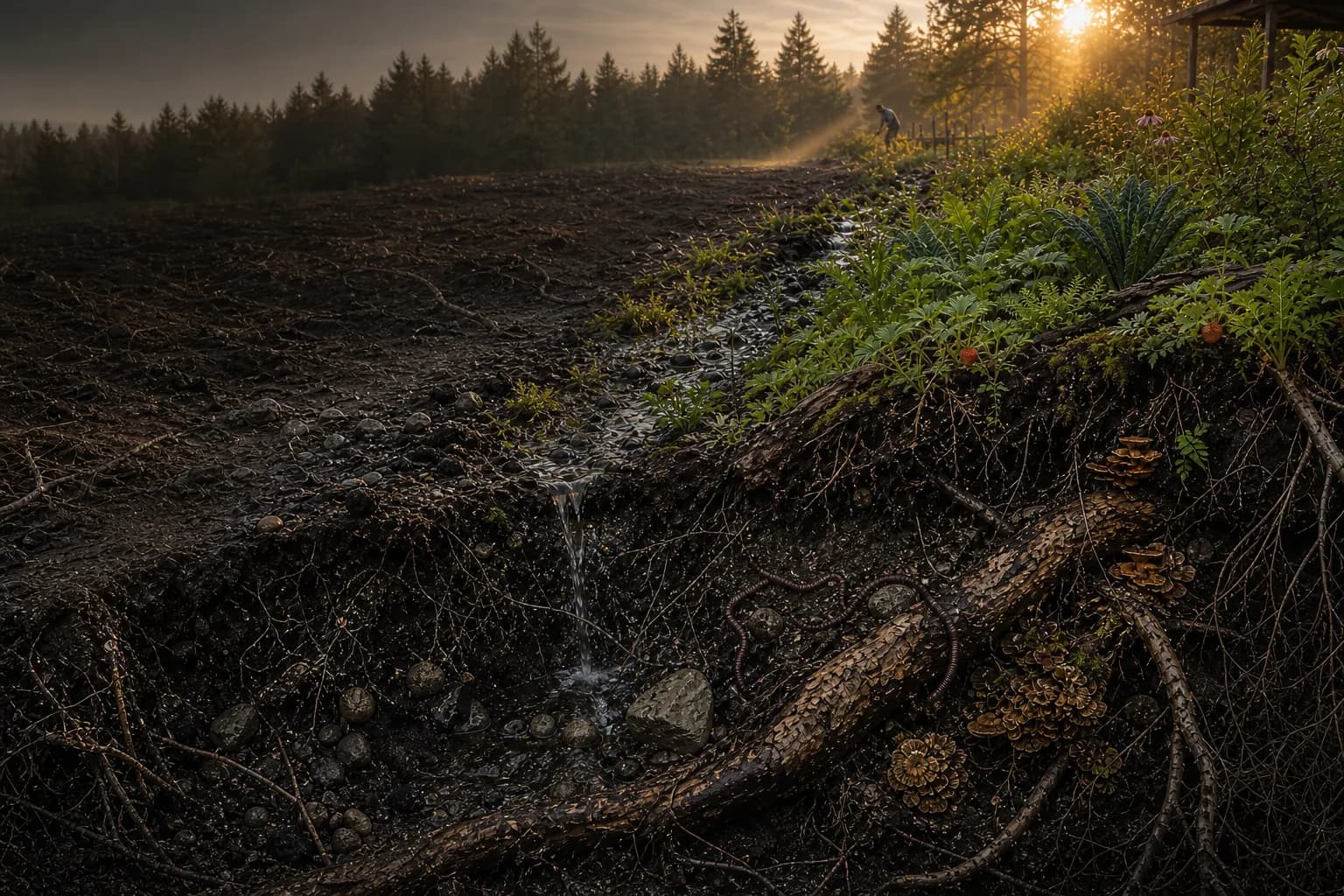
In a forest, fallen logs rot slowly into the ground and become sponges for water and homes for fungi. Hugelkultur tries to copy that on purpose: pile logs and branches, cover them with soil and organic matter, and plant on the mound.
The idea is appealing, and the claims for it are big: beds that hold water, feed themselves, and need little irrigation. The question is how much of that has been tested.
What the research shows: very little
Washington State University Extension states plainly that there are no peer-reviewed scientific studies on hugelkultur. Some student projects exist, it notes, but none had been published in journals.
What little exists is preliminary. Kansas State University researchers began growing pumpkins and lettuce on hugelkultur beds in 2020 and observed that the south-facing slopes dried out faster than the north-facing ones; their data analysis was still pending. A 2016 undergraduate honors thesis at Western Kentucky University reported higher water-holding capacity in hugel mounds, but it wasn't peer-reviewed.
Absence of evidence isn't proof it doesn't work. It means anyone who tells you exactly how much water a hugel bed saves is guessing.
Known downsides
Extension services agree on a few practical problems. Washington State University notes that mounds collapse as the wood breaks down, usually within five or six years, and need rebuilding, which makes them a poor home for fruit trees and shrubs. Weeds move in quickly unless the mound is mulched.
University of California Master Gardeners advise letting a new mound rest a few months so decomposing wood doesn't tie up nitrogen the plants need, and expect it to sink over time. Clemson Extension suggests topping it up as it settles.
If you build one: wood to use and avoid
Build on a gentle slope or level ground, keep it away from buildings, and treat it as an experiment: plant the same crop in a flat bed nearby and compare.
- Put the largest wood at the bottom, and leave out diseased wood or leaves (Clemson Extension).
- Avoid black walnut and black cherry, which release chemicals that can inhibit other plants, and never use pressure-treated wood (UC Master Gardeners).
- Use cedar and redwood only sparingly, since they break down very slowly (UC Master Gardeners).
The better-tested option: wood on top
If the goal is to put wood to work for soil and water, there's a well-studied alternative: wood chips on the surface. Washington State University's Linda Chalker-Scott, who is skeptical of hugelkultur, ranks arborist wood chips among the best mulches for holding moisture, and notes that a 4 to 6 inch layer controls weeds.
Her research summary notes that chips tie up nitrogen only at the thin boundary where they meet the soil, which helps suppress weeds, and raise soil nutrients over time. Chips haven't been shown to attract termites, though they should be kept off foundations. Her advice: use wood on the surface, or as edging and nurse logs, rather than burying it.
Where that leaves us
Hugelkultur might hold water well, and some gardeners swear by it. But the honest answer today is that it hasn't been properly tested, and it has real maintenance costs. If you try it, try it small, measure what happens, and keep proven practices like mulching and water harvesting as your foundation.
Sources
- Hügelkultur: What Is It, and Should It Be Used in Home Gardens? (FS283E) Washington State University Extension
- Hugelkultur bed research (Hazan & Cowan, 2020) Urban Food Systems Symposium, Kansas State University
- Hugelkultur honors thesis (Laffoon, 2016) Western Kentucky University
- Hugelkultur: Mother Nature's recipe UC Master Gardeners of San Mateo and San Francisco Counties
- Hügelkultur Gardening Clemson Cooperative Extension
- Using Arborist Wood Chips as a Landscape Mulch (FS160E) Washington State University Extension
General guidance, not advice for a specific site. Local conditions, rules, and your county extension office come first.